


Trivia Game: Millionaire Quiz
4.3187.00 Reviews
App Specs
- Version
- 1.75
- Updated On
- License
- Free
- Downloads
- 1,000,000+
- Developer
- Clappy LLC
- Categories
- Trivia
- Platform
- Android, iOS
Screenshots


 Analysis by AppCompare
I usually reach for a trivia game when I have a few spare minutes, but I prefer one that gives each answer a little weight instead of firing questions at me without a purpose. The millionaire-show format in Trivia Game: Millionaire Quiz offers that familiar climb: begin with accessible questions, then decide whether I’m confident enough to keep going as the stakes rise. It’s a straightforward idea, and its appeal depends less on elaborate extras than on whether I enjoy testing what I know under gentle pressure.
A useful goal for a short session
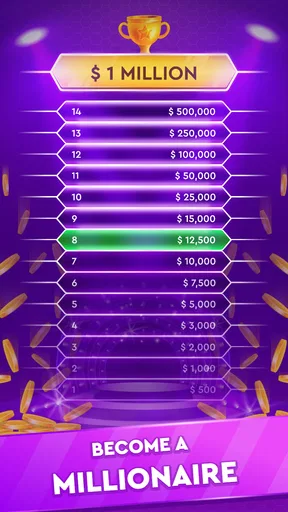
The first objective is easy to understand: answer correctly and work toward the top question. That clear finish line makes the game approachable when I don’t want to learn a complicated set of rules. I can open it, focus on the question in front of me, and get a sense of progress from moving through the familiar ladder of difficulty. For a quick break, having one obvious aim is a genuine strength.
That structure also gives me a practical way to play with someone else nearby. One person can read the question while another thinks, then both can discuss why an answer seems plausible before choosing. It turns a solo quiz into a small conversation without needing a separate board game or a long setup. I’d use it for a relaxed wait or a casual evening, rather than expecting it to replace a dedicated party game.
The format rewards measured confidence more than speed. A useful habit is to pause briefly before answering and identify whether I know the fact, can infer it, or am simply guessing. That small distinction makes each choice feel more deliberate and can help me notice which subjects deserve a bit more attention. It is also a good way to keep a run entertaining when I’m playing alone: the challenge becomes not just getting an answer right, but judging how sure I am.
What progress feels like
In a ladder-style quiz, progress is easy to read because each correct answer takes me nearer to the final question. That’s a different sort of feedback from a collection of unrelated quizzes, where improvement may be harder to feel from one round to the next. Here, the immediate signal is whether I can keep the run alive as questions become more demanding. I find that satisfying, but it is not the same as a detailed learning plan or a record of long-term mastery.
For a more useful practice routine, I’d treat missed or uncertain questions as prompts to follow up on after playing. If I’m unsure about a history answer, for example, I can make a mental note and look up the topic later rather than assuming a lucky guess means I’ve learned it. This approach keeps the game’s quick format intact while turning it into a springboard for curiosity. It’s a modest but worthwhile trade-off: the quiz supplies the nudge, while deeper study has to happen elsewhere.
The game is developed by Clappy LLC and sits in the trivia category. It is free to start, rated for Everyone, and has an average rating of 4.4 from around 27,000 ratings; it has passed one million installs. Those figures suggest that it has found an audience, though popularity alone doesn’t tell me whether its style will suit a particular player. I’d focus on the central question-and-ladder loop when deciding, since that is the part most likely to determine whether I return.
Worth Reading Before You Choose

EA SPORTS FC Mobile 26 Is a Bigger Football Game, but It Takes Time

Flipboard Shows What News Apps Must Do Beyond the Feed

Switching to Android Auto Means Rethinking Your Driving Routine

Google Calendar Makes a Crowded Week Easier to Manage

Ludo King Makes the Most of the Minutes Between Plans

Baby Panda World Brings Quick Play to Modern Phones, but Its Game Library Feels Busy
Where the difficulty can test patience
The rising stakes give the game its tension, but they also create a familiar weakness: a single obscure fact can interrupt a promising run. That can feel exciting when I’m making an informed choice, and frustrating when a question lands outside the subjects I follow. A broad mix of general knowledge is a better fit for players who enjoy surprises than for someone who wants every round to stay within a chosen topic.
I also wouldn’t treat every correct answer as proof that the overall challenge is perfectly calibrated. Trivia knowledge varies widely from person to person, so one player may breeze through a question that stops another early. When a run ends quickly, I find it more helpful to see it as a snapshot of the questions I encountered than as a verdict on my intelligence. That mindset keeps the game light rather than turning every loss into a reason to quit.
Compared with a rapid-fire quiz, the millionaire format gives individual answers more breathing room and makes the sequence itself matter. Compared with a study-focused flashcard app, it is less suited to deliberately revisiting specific facts. I’d choose this game for a compact challenge with a clear endpoint, and choose a topic-based learning tool if my main goal were systematic revision. The distinction matters: a fun test of general knowledge and a structured course can both be useful, but they solve different problems.
Keeping play enjoyable without forcing a routine
A free game can be easy to try, but optional spending is still worth considering before settling into regular play. In-app purchases range from $0.99 to $29.99 per item, so I’d avoid buying anything impulsively just because I’m eager to continue a session. A sensible approach is to play casually first, decide whether the basic experience holds my interest, and only then consider whether any purchase offers value for the way I actually play.
That also makes this a better fit for someone who is comfortable with a simple, self-directed routine than for a player who expects a strong progression system to keep supplying new goals. The ladder already gives a round a destination, but I wouldn’t rely on a trivia game alone to build a daily study habit. If I wanted to learn a subject in depth, I’d pair occasional play with reading or a dedicated quiz resource instead of expecting repeated rounds to do all the work.
On an ordinary day, I might open it while waiting for a coffee or during a quiet stretch before an appointment. I’d play one focused run, stop when I need to move on, and save any question that genuinely surprised me for later. That use case suits the game better than trying to stretch a short mobile session into a long evening of entertainment. It gives me a quick mental diversion without requiring a group, a plan, or a large block of time.
Who will enjoy the format
I’d recommend it to casual trivia fans who like general knowledge, recognize the appeal of a rising-stakes quiz, and want something they can pick up without much preparation. It can also work for friends or family members who enjoy talking through possible answers together. The Everyone age rating makes it broadly accessible, but the best match is still someone who likes questions across varied subjects and can shrug off an early wrong answer.
I’d suggest skipping it if you mainly want a tightly organized learning tool, a quiz limited to one subject, or a game whose appeal depends on a deep narrative or complex mechanics. It may also disappoint anyone who dislikes uncertainty: trivia can move from easy to unfamiliar without warning, and that unevenness is part of the format. Choosing a specialist quiz or a flashcard app would make more sense if control over topic and repetition matters more than the suspense of a climbing challenge.
The current version is 1.74, and the game requires Android 7.0 or later. It is a mobile option rather than a substitute for a full-length quiz night, so I’d think of it as a convenient pocket-sized test. That distinction helps set expectations: its value is in making a spare moment feel like a small challenge, not in offering every feature a larger multiplayer or educational platform might provide.
Gameplay and Features
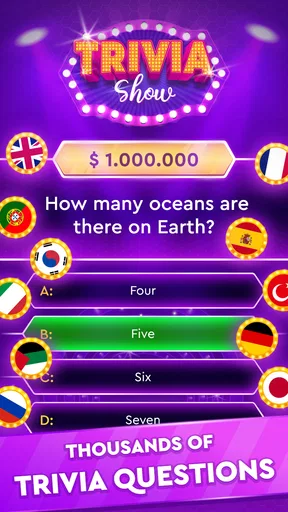
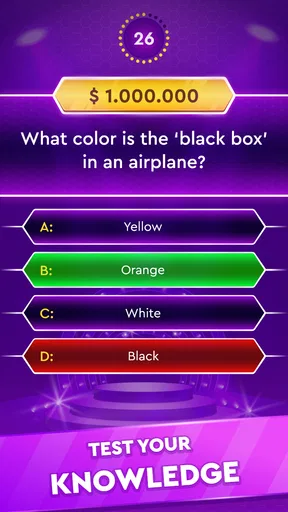
The core of Trivia Game: Millionaire Quiz stays true to the classic game show format. You start with a simple question, and as you answer correctly, the stakes get higher. The ultimate goal? Reach that coveted million-dollar question without faltering.
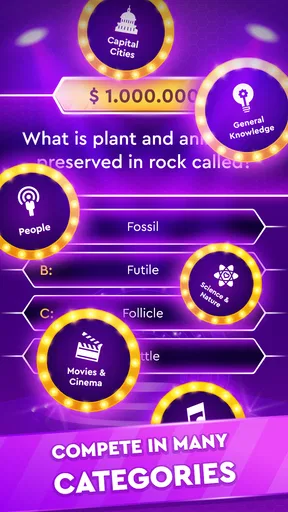
What I appreciated right off the bat is the variety of questions. The app doesn't just stick to general knowledge; it branches out into categories like science, history, pop culture, and even some quirky trivia that keeps you on your toes. This keeps the game fresh and engaging, making each session feel like a new challenge.
Visuals and User Interface
The design is sleek and intuitive, which makes navigating through the game a breeze. The developers have done a solid job of capturing the game show's essence without overwhelming you with unnecessary graphics. The simple color scheme and clean fonts make it easy on the eyes, even after a long trivia binge.
Also, the animations when you answer a question or use a lifeline add a nice touch. They’re subtle yet effective, enhancing the overall experience without being distracting. It’s clear the app is designed for both casual players and trivia buffs alike.
Lifelines and Challenges
Just like in the TV show, you get lifelines to help you out of tricky situations. The usual suspects are here: 50/50, Phone a Friend, and Ask the Audience. I found myself relying quite a bit on the 50/50, especially when faced with those head-scratching questions about obscure facts.
One of the coolest features is the daily challenge. This mode pits you against other players worldwide, and let me tell you, the competition can get fierce. It’s a great way to test your skills and see how you stack up against other trivia enthusiasts. Plus, there are rewards to be earned, which adds a nice incentive to log in daily.
Monetization and Ads
Now, let’s talk about the dreaded part of many free apps: ads. Trivia Game: Millionaire Quiz does have ads, but they’re not too intrusive. They usually pop up between rounds or when you opt to gain extra lifelines. There’s also an option for in-app purchases if you want to get rid of them entirely, which I found to be reasonably priced.
While ads are present, they don’t break the flow of the game. I've played many apps where ads felt like an obstacle course, but here, they're more like a minor detour.
Community and Multiplayer
One of my favorite aspects of the app is its community feature. You can connect with friends, challenge them to matches, and even form trivia teams. It’s a fantastic way to make the game more interactive and social. Plus, the app hosts regular tournaments, which are a blast and come with enticing rewards.
The multiplayer mode is seamless, and I didn’t experience any lag or connectivity issues. It’s perfect for those times when you want to prove your trivia prowess to your friends or random players across the globe.
How the progression holds up
For me, the strongest progression signal is the climb through the question ladder. It gives a round a natural arc without asking me to manage a complicated roster or plan a long campaign. That simplicity is useful when I have only a few minutes, although it also means the satisfaction comes mostly from the quiz itself rather than from a deep collection of unlocks. Players who want a detailed progression tree may find the format too lean.
The lifelines add a decision point to that climb: use help when uncertainty feels uncomfortable, or save it for a question that seems more dangerous. I’d try not to spend one automatically just because a question is unfamiliar. First, I’d eliminate any choices I can rule out, then decide whether the remaining uncertainty is worth a lifeline. That makes the choice feel strategic instead of routine and can help a short session stay engaging even when I don’t know every answer.
There is a useful trade-off here. The show-inspired structure is immediately recognizable, so it doesn’t need a tutorial-heavy introduction, but familiar conventions can also make the experience feel less surprising to people who have played many similar quizzes. I’d choose it when I want a recognizable challenge and a clear finish, not when I’m looking for a radically different take on trivia.
A practical way to decide whether to keep playing
After a few sessions, I’d ask myself whether I’m enjoying the questions even when I don’t reach the final one. If the answer is yes, the game is doing its job as a quick source of curiosity and challenge. If I’m only enjoying it when I win, the unpredictable subject mix may make it feel more irritating than rewarding. That is a useful test before investing time or money in any optional extras.
For parents or people choosing a game to play together, I’d keep the focus on conversation rather than treating a score as a measure of who is smartest. The broad trivia style can give different players a chance to shine in different areas, and explaining how someone reached an answer can be as enjoyable as getting it right. For solo use, a quick note of topics that repeatedly catch me out can turn the experience into a more intentional break without demanding a formal study schedule.
Final Thoughts
All in all, Trivia Game: Millionaire Quiz is a must-have for trivia lovers. It perfectly balances the nostalgia of the original game show with modern mobile gaming features. Whether you're looking to kill some time, challenge your brain, or engage in friendly competition, this app has something for everyone.
If you’re someone who enjoys testing your knowledge and loves a good challenge, give this app a shot. Just beware, it might become your new trivia addiction!
My progression verdict
I see the game’s progression as a compact challenge rather than a promise of endless goals. The climb gives each run direction, the rising difficulty creates tension, and lifelines offer a small but meaningful choice about when to protect a run. That can be enough to make a spare moment feel satisfying. It is less compelling if I want a carefully staged curriculum, extensive control over subjects, or a progression system that keeps opening new layers.
Pros
- Engaging questions that challenge your knowledge.
- User-friendly interface with intuitive navigation.
- Regular updates with new quizzes and challenges.
- Multiplayer mode to compete with friends.
- Offline play available for on-the-go fun.
Cons
- Limited lifelines can make some questions tough.
- Ads can be intrusive during gameplay.
- In-app purchases for additional features.
- Occasional crashes on older devices.
- Some questions repeat after a few sessions.
FAQs for Trivia Game: Millionaire Quiz
What is the main objective of Trivia Game: Millionaire Quiz?
Trivia Game: Millionaire Quiz aims to simulate the excitement of a television quiz show, challenging players with a series of questions across various topics. The goal is to answer correctly and progress through increasingly difficult levels, ultimately reaching the top prize. It's a test of knowledge and quick thinking.
Are there any in-app purchases in Trivia Game: Millionaire Quiz?
Yes, Trivia Game: Millionaire Quiz offers in-app purchases that can enhance the gaming experience. These include lifelines or additional question packs to help players when they're stuck. While the game is free to download, these purchases can provide advantages or additional content.
Can I play Trivia Game: Millionaire Quiz offline?
Trivia Game: Millionaire Quiz requires an internet connection to access the latest questions and participate in leaderboards. However, some game modes may be available for offline play, allowing users to enjoy the game without a connection, though with limited features.
How frequently are new questions added to Trivia Game: Millionaire Quiz?
The developers regularly update Trivia Game: Millionaire Quiz with new questions to keep the content fresh and challenging. Updates are typically released monthly, incorporating user feedback and trending topics to ensure a diverse and engaging experience for players.
Is Trivia Game: Millionaire Quiz suitable for all ages?
Trivia Game: Millionaire Quiz is designed for a wide audience, but it is generally recommended for ages 12 and up due to the complexity of some questions. The game encourages learning and critical thinking, making it suitable for teenagers and adults alike. Parental guidance is suggested for younger players.


